An old teacher of mine, perhaps in high school, told us a futurist is not someone who’s psychic — they’re someone who has superior insight into trends.
They use that insight to predict all sorts of things, typically things you and I might find suprising or alarming. The futurist pays attention. They note small details you and I usually miss because we’re distracted, disinterested, or both.
Mark Carney stepping up now to be the Liberal candidate for Prime Minister just as there’s a trade war with the US and a broader re-sorting of global economic assumptions was predictable.
Let’s fine tune that point a bit. The Canada-US trade war and broader re-sorting of global economic assumptions was predictable. As for Mark Carney… well I’ll get to that.
I’ve had a week of feeling kind of sorry for two of the three major parties. This is shaping up to be a Liberal landslide. I even feel comfortable typing that out, publishing it to this obscure blog, and standing by it for years to come. I am not even worried about jinxing that outcome because it is the one I’m hoping for.
(Don’t come at me with: “Remember what happened with Donald and Kamala!” My friends, you’ve forgotten D and K were in a statistical dead heat for weeks leading up to election day. You’ve also forgotten the warnings of people like James Carville: that D underpolls. So it was never really a tie and D always had a strong shot to win. Those of us on the other side just couldn’t believe it would actually happen. Again.)
But my feelings of pity — I can’t find a better word, and pity is an imperfect one in this case — are quite different between the NDP and Conservatives.
I feel badly for Jagmeet Singh, who I have always really liked. I forgave him for running in a BC riding when he became leader even though he had no prior connection to BC (the riding — then — was presumably a safe NDP seat).
When I saw Jagmeet and his spouse in North Vancouver a few years back, I yelled out from several metres away, “Jagmeet Singh!” And when he came close enough, he smiled and shook my hand. He did not avoid my gaze or smirk awkwardly with a look that said, “who is this crazy person?” No, he just smiled sincerely when he greeted me.
Now there’s video of Jagmeet walking by himself on airport tarmacs in the rain, looking sunken as the NDP is in single digits in national polling. This after the supply and confidence agreement the NDP had with the Liberals actually brought tangible results to Canadians to whom they actually matter. (At least, that’s what they say. I believe them.)
My pity for the Conservatives is probably poorly defined as pity, because I think they were just ill prepared — and ill prepared to such an extent that really isn’t forgivable for a major Canadian political party. Combined with the fact that they’ve placed all their bets on a candidate who appears to me to be highly malleable, able to be nudged further right for the sake of apparent political gain without a conscious awareness of how far right he’s going, I don’t feel sorry for the Conservatives exactly. I guess I am just flabbergasted that they could have been so ill prepared, so politically dumb.
Side note: I am also angry as a Canadian voter. Because when one of our major parties drops the ball, thinking they can run on populism instead of policy, it’s us who suffer. It’s us who end up with poor choices. It’s us who have to choose the least bad option. Governance is serious business. Governance happens as a function of political parties, and those parties have a responsibility to demonstrate how they would govern, not just how they would get our votes. Shame on you, Conservatives. Shame on you.
Side note extension: In 2006 Stephen Harper was elected Prime Minister of Canada. Or to put it more accurately for this discussion, he was the head of the Conservative Party of Canada, which got the most number of seats in the House of Commons, falling short of a majority. At that time, I remember saying to someone, whom I suspected was a Conservative, that I was actually ok with the outcome, even though I hadn’t voted Conservative. I felt that governing parties, if they spend too much time in power, as I felt the Liberals had at that point, could become entrenched. When a governing party is entrenched, they begin to forget who they are ultimately accountable to (us, Canadians) and responsible for (us, Canadians). So I was glad for the Liberals to sit it out in opposition for awhile. But let’s also remember that a 2006 CPC was still essentially a centre-right party as the Liberals were probably centre-left. It’s not clear the ideological makeup of the parties is the same today.
So with that said, thank God the Liberal choice is Mark Carney, who’s never been in politics (technically) but has spent a lifetime in governance. Thank God.
But this too was predictable. Mark Carney didn’t just land here out of some kind of weird luck. He saw this moment coming, and he positioned himself to be right there ready when it came.
So, let’s lay it out. The predictability of the southern chaos, the rise of Carney, the stalling of the Conservatives, and the NDP — specifically what I heard a Conservative operative recommend the other day: that the campaign should work to get once-NDP, now leaning-Liberal voters to “go back home (to the NDP).”
Let’s say you are a futurist. You pay attention to things. So after Donald Trump lost the 2020 election, you noticed some key facts. There are the obvious ones, such as the denial of the election loss and all of the subsequent dramatics.
But the more essential facts are these: the complete absence of a viable candidate on the right in the wake of the Trump loss and the mass exodus of reasonable minded advisors from Trump’s inner circle. There was also what I would call a perfectly normal electorate, one that’s under strain perhaps, doesn’t spend a lot of time thinking about politics, and certainly isn’t tied to party labels. At the end of the first Trump term, he lost. But he still held a large segment of the electorate. So with no other alternative on the right, it was entirely predictable that Trump would run again, and that he would win.
This time around, it wasn’t going to be a new Trump; it was going to be a Trump unrestrained by reasonable minded advisors who still held fast to the idea that the system was worth preserving. This was also forseen by many, who sometimes appeared alarmist with their warnings of an autocratic second Donald Trump presidency. A lot of us just didn’t really want to believe it.
Recent events such as the trade war with Canada, global tariffs and an overall attempt to run American foreign affairs like a boardroom negotiation, were all foreseeable for anyone who was paying attention. D has never given any indication he wanted to run the country any differently than he ran his businesses, and his stance against allies should have been easy to predict with even a cursory understanding of how he conducted those businesses.
So a futurist would have foreseen this trade war with Canada and the global economic chaos.
Then there’s Mark Carney.
So, our good buddy Mark. I barely knew who Mark Carney was before he was elected Liberal leader 33 days ago. (Since we’ve still got 17 days until election day I guess I should be cautious with my prediction of a Liberal landslide. After all, I’m not a futurist. Or a pollster). I am not even sure I saw that Daily Show interview when it originally aired in January.
But Mark has obviously been around political circles for a very long time, here and elsewhere. There’s a rumour Harper asked him to run as a Conservative in 2012. He’s predictably noncommittal in old interviews, never saying he would run, never saying he would rule it out.
There’s an interview from about a year ago where Rosemary Barton asks Carney if he’d consider running in a by-election if it became available or in the next general election. By-election? By-election. As if Carney ever wanted anything less than the top job. It makes me wonder if he would (will) stay on as opposition leader once the Liberals are (several years and possibly 1 or 2 elections from now) finally displaced from the governing position.
But clearly he was waiting for his moment. Bank governors, let’s not forget, are kinds of futurists. They analyze trends, notice stuff, and make predictions. They don’t manage to fulfill their mandate by reactionary measures without sound thought and predictive modelling (or at least they shouldn’t).
So Mark Carney, I suspect, at the time of that Rosemary Barton interview, could predict the second Trump term and the resulting chaos.
He also would have seen what everyone else in Canada saw — the steep decline in Trudeau’s favourability, which meant a potential opening in the top Liberal job. (By-election? Please. I like Mark Carney, and I am certain he respects his caucus. But I also think he grimaces at the word “backbencher” attached to his own name).
At this stage, this is what we have: pending economic chaos and threats against Canada. Paired with an unpopular leader.
You know the Liberal party must have wanted to get rid of Justin Trudeau for awhile. But I believe they waited, and more importantly Mark Carney and his advocates in the party waited, until it was late in the game to push him out. They wanted to wait until the threat to Canada was clear, so after the November election. The futurists could see the economic war on the horizon.
So lame duck Trudeau (to use an American phrase) gets the ball rolling in recovering the Liberal party fortunes. Let’s not forget Trudeau’s role here, standing up for Canada, getting lots of US airtime responding to Trump’s initial and seemingly nonsensical threats and demeaning talk about our country. We liked that. We all did.
But at the end of the day, he was still Justin Trudeau, whose sparkle as a candidate had long faded. He represented a different kind of political ideology, one that values inclusion in the way it’s framed in identity politics just as people were losing patience with what they perceived to be identity politics. (Personally I liked that he had gender equity as a principle in his cabinet appointees, but it doesn’t bother me that Mark Carney doesn’t follow that principle). Trudeau was no longer as politically toxic as he had been with the new — but predictable — threat from the US in play. But any new Liberal leader would have to dissociate from him.
Meanwhile, Carney, who’s always been pressured to run, has an opportunity to use his one asset to land the top job. Let’s reinforce that point. Mark Carney has precisely one political asset: his economic experience.
At any other time in history, without the chaos from down south, his political candidacy would be lukewarm at best. He’s charismatic and personable, in some settings, but in others he’s bland. (I had originally written “milk toast” here, thinking it meant dull, unexciting, and boring, but I discovered that isn’t the technical definition of that phrase. But if “mlik toast” means to you what it means to me, Mark Carney is milk toast).
At the Liberal rally I attended last Monday in Richmond, BC, Carney sounded bored with his own stump speech. As I stood in the crowd behind him, straining to see the crown of his head despite massive lights and several people much taller than me, I was glad for the welcome interruption of people yelling things like “fight the autocrat!” And, “you can do it, Mark!” At the time, I thought they were just members of what seemed to be a very jacked up Liberal crowd, but maybe they interrupted his speech because they were bored and wanted to lighten things up.
This is the retail politician version of this Mark Carney, the Bank of England governor, who in this clip during Brexit negotiations in 2019 tells a reporter that financial stability does not mean market stability and does not mean economic stability. Retail politics must be a weird fit for this Mark Carney, who I perceive (having never met him) to be pretty introverted and not very comfortable with this whole idea of political sloganing.
Which is a strength. It is a strength in this circumstance to have a politician who is ill-at-ease with retail politics but very solidly grounded in global economics. Which again goes back to the point that Carney is perfect for this moment, but he saw it coming. He was prepping for it, waiting in the wings until it was time.
But he was smart to give the other side very little time to adjust. Which leads us to the Conservatives, who made a couple of critical errors: besides not preparing for a candidate other than Trudeau, they did not hire any futurists. They did not act like futurists. They did not predict the threat against Canada, which was plainly obvious for all to see.
Possibly, they might have thought they could simply import US-style right wing politics into Canada. But I don’t think so. From some angles, it looks that way right now, but I think the big mistake was just relying too much on Trudeau’s unpopularity.
And not thinking ahead. Because when you’re 25 points ahead in the polls, why do any real work? Just start making deals and planning your cabinet picks.
Which translates to pure political laziness. It was not only sloppy, but naive. The Conservatives apparently made the assumption their massive lead (now completely evaporated) was because of growing right-wing sentiment, instead of recognizing it for what it actually was: people picking the least worst out of a selection of bad options.
And that support was probably soft. I had a conversation with a friend sometime last year, someone I see frequently but with whom I rarely discuss politics. I didn’t even know she had any political interest at all, until she volunteered, “I know this is controversial to say, but I think I want to vote Liberal.” I gathered that, in whatever circles she was in at the time, voting Conservative was the socially acceptable thing to do. But she’d had a look at what the Conservatives were actually proposing, and she wanted to vote Liberal.
So I will argue this: the influx in new Conservative support was never that strong to begin with, and with Mark Carney all we have is a reversion to a time when voting Liberal was socially acceptable. The “change” message touted by the Conservatives on those ads that went on for maybe a year or so that implied Trudeau had devastated the country was simply flipped on its head. We’ve got change. We’ve got Mark Carney now.
Because subpoint of “dumb Conservative strategy” was not targeting the Liberals in those ads. They targeted Trudeau. Which is just so politically stupid. Ok, I am a person who doesn’t like to have my opinions made for me, and I’m not fond of attack ads that circulate constantly more than a year before an election is even called — this falls into creepy propaganda territory — but if you’re going to use constant rhetoric to brainwash Canadians into thinking someone was to blame for whatever ills you say exist in Canada, let it be someone who can’t be just swapped out for a different candidate in a matter of weeks.
That brings us to the last point, which seems like a small one, but it’s a big one for me. Kory Teneycke, a Tory strategist, has criticized the federal Conservative campaign. In an interview on CTV a couple of days ago (which I won’t link to, because I can’t immediately find it) he gave some options for what the Conservatives could do to try to recover in the waning days of the campaign. One of the factors in his analysis was the NDP voters who are now voting Liberal would go “back home” to the NDP.
Let’s talk about those strategic left voters, who are shifting their votes to red to keep out the Conservatives.
I think the idea of NDP voters “going home” is not just wishful thinking, but also reflects a inaccurate perception of who NDP voters are.
Let’s step back for a second and remember the disconnection between provincal NDP voters and federal NDP voters. Many of us Canadians think of our provincial politics as our home politics. In British Columbia, where I am and have been for most of my adult life and my entire childhood, we’ve traditionally only ever had a left government when the right was split. The left has for decades been the NDP and sometimes Green. The right was for decades the BC Liberals. It was widely known that if you voted for a BC Liberal, you’d probably be voting Tory federally. Christy Clark, our onetime BC Liberal premier, got into a bit of a fight over semantics several weeks back when the idea of her running to replace Trudeau was being floated, and she incorrectly said she’d never been a member of the federal Conservative party. To me, this wasn’t scandalous; the idea of her running for the federal Liberals was the more shocking part. Because she wasn’t, in my mind, a Liberal.
So party labels mean something different at the provincial level. And at the provincial level, the NDP can actually form government.
In federal politics, that isn’t possible. Federal NDP voters know they are not voting for an MLA who’s going to be in the caucus of the governing party. They know that. But they vote NDP because of the appeal of the individual MLA, because of the prospect of a balance of power that keeps the Liberals and Conservatives in check, or because of the NDP’s platform.
But critical here is that, although the NDP voters know they won’t form government, they are hyperconscious of who will form government. We’ve heard the vote-splitting criticism time and again. (But this is a democracy and we need voices from across the spectrum, especially now when we have one party, the Conservatives, who represent a void of real capability and ideas when it comes to governing. That is why the NDP, the Bloc, the Greens are essential and should always have a place in politics. Or if they one day form government, that the Liberals or Conservatives give a voice to those who are on the outside of the main houses of power). Hence the mass exodus away from sweet Jagmeet and his team of dedicated pubiic servants.
Early in the campaign, an old friend posted on social media he was considering voting Liberal for the first time ever. He didn’t seem happy about it. Carney was newly appointed leader and I gather voting for him wasn’t top of my friend’s want to do list. But the Conservative leader was so repugnant to him, he was going to move to the Liberals to keep the man out. I believe this sentiment is common. I believe many of us who oscillate through the left-leaning parties are visiting sites like votewell.ca this time to really make sure our votes count.
Side note: Speaking of votesplitting, this is the image I get on votewell.ca as of today for Nanaimo Ladysmith (not my riding). Since the colours might be obscured, let’s lay it out: Conservative 35%, Liberal 21%, NDP 21%, Green 22%, People’s Party 1%. And in the few hours since I’ve taken the screenshot, the numbers have already changed.
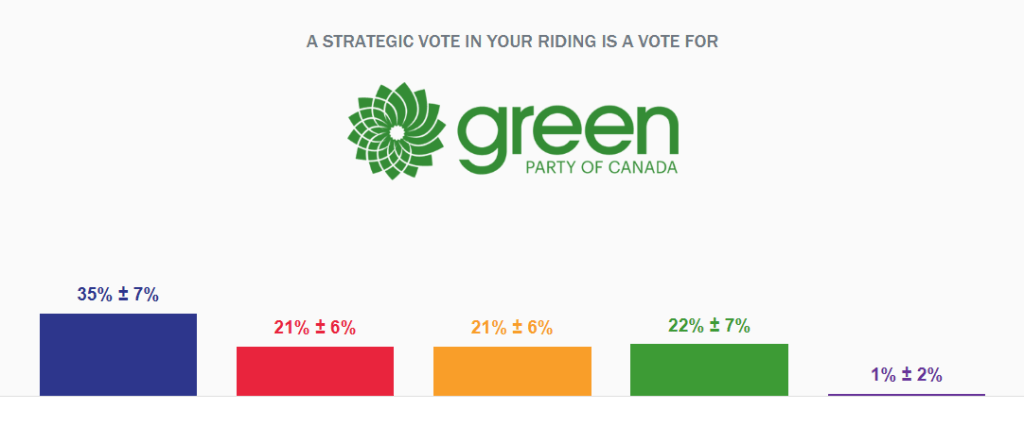
This kind of result is what those against third parties are afraid of. But democracy can be a beautiful delicate balance when it’s done right, and we should welcome voices and not exclude them. As Tom Mulcair said recently, when he urged NDP voters to come on to Carney’s side, “When I was NDP leader I used to bristle when I heard Liberals warn about not “splitting the vote.” It seemed so entitled, as if “the” vote belonged to them.”
Exactly.
But there’s also been a shift of late among those voting Liberal. I believe, and this is purely anecdotal, that more and more people aren’t just voting against the Conservatives. They’re voting for Mark Carney.
Yesterday, a friend messaged with me with the link of Mark Carney’s interview with Nardwuar. This friend, yet another I hadn’t perceived to be overly politically active or interested, said it was “such a different approach compared to JT.” My friend said now he wanted to vote Liberal. He’d always voted NDP and NDP was still the best strategic choice in his riding. But clearly Carney had won him over.
The question is why. Why has Mark won so many people over? Well, I think the answer is pretty obvious. Sure, there’s the banker’s experience, blah blah blah. But really, it’s encapsulated perfectly in the first comment here posted in response to one of Carney’s Instagram videos a few days ago:
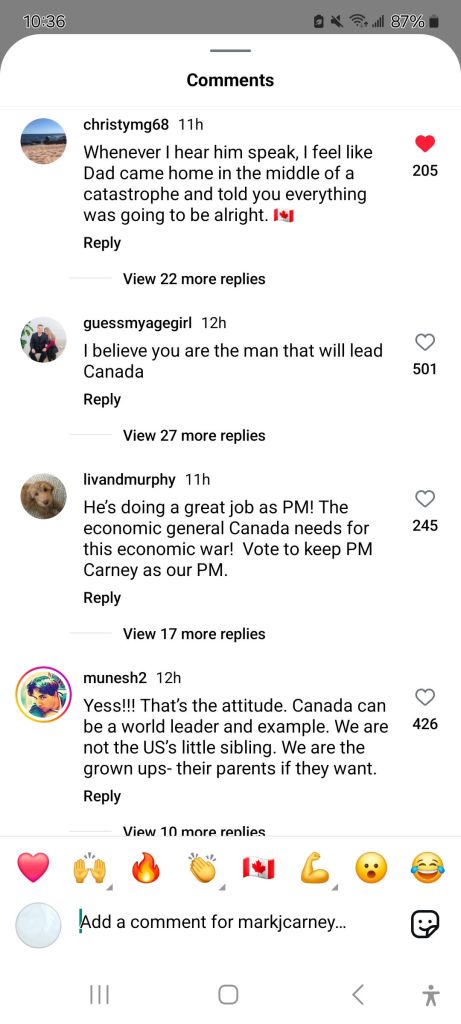
And that’s it.
I’m too old to think of Carney as a father figure and I don’t. But I could make the analogy that if I worked alongside Mark Carney and we were faced with some substantial crisis, I would feel comfortable and reassured that he was there, on our team, partnering with us to help us through it.
He’s even said as much on the campaign. At that rally in Richmond, when someone shouted, “you’ll do it!” Carney awkwardly departed from his speech to say, “we’ll all do it.” It’s a stroke of leadership, to posit the prospect as one of collaborative intention that he will lead us through. Contrast with an ideological and autocratic proposal, a la DT: “I will make everything right. Just shut up and trust me.”
On that note, I have a recommendation for my fellow Canadians who have actually read this post. Take a break from American media. Or if you follow it closely, don’t get caught up in their politics. Remember American politics is its own bubble. We see things from the outside they just don’t see. It’s to our benefit to stay aware, but not get bogged down in the weeds. The U.S. is no longer the focus of our identity. We no longer have to be content with that weak identity of “not American.” We’re Canadian. We’re strong. And our time has come.
Postscript: I didn’t know until today that it had been Nardwuar whose question had resulted in this famous response from Jean Chretien:

 Mark Carney is Awesome
You must be logged in to post a comment.