This post was going to be about getting momentarily triggered by hearing “Gregor Robertson” and “Housing Minister” in the same sentence earlier today. But it’s been superceded — or supplemented — by the tone deaf post made by Nate Erskine-Smith, current podcaster and former Housing Minister.
In response to the cabinet (or “ministry” as Mark Carney calls it, as if he’s starting a new religion — perhaps the religion of Canada where the core beliefs are universal health care, spelling “neighbour” with a “u”, and celebrating Thanksgiving in October. What else would the religion of Canada be?) picks earlier today, Erskine-Smith posted on social media that “the way it played out doesn’t sit right and it’s impossible not to feel disrespected.”
I guess Nate Erskine-Smith was Housing Minister for awhile, and expected to be Housing Minister again.
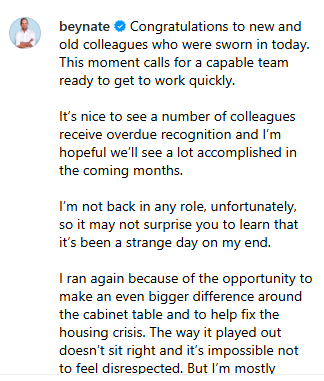
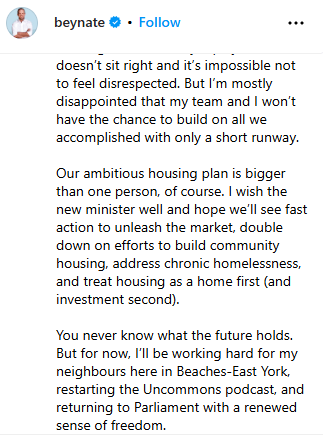
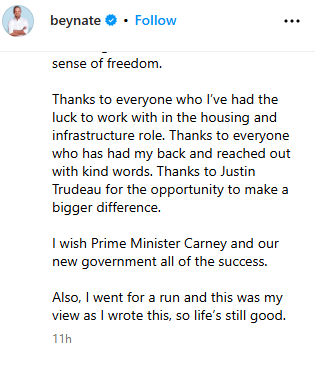
The post is a reminder of one thing: that politics is a pretty insular profession. And for many it is a profession. It is a career path and not an act of service.
So, what, Nate. What? Did Mark Carney promise you the Housing file if you ran again and once you got re-elected you found yourself out of cabinet? Well, deal with it. Cabinet might actually be better termed a ministry, come to think of it — a statement of ideals that go beyond any particular individual and is designed for the higher good.

The arrogance of “feeling disrepected.” You were re-elected. That should be enough. The arrogance of thinking you are owed a place in ministry. The subtle dig at Carney by thanking Trudeau in your post. This entitlement is exactly why people hate the Liberals. Let it be said, people’s memories are long, and don’t think that just because Carney almost got a majority people have forgotten the tendency of long-time politicians to treat governance like a social club where cabinet — sorry, ministry — appointments are shuffled about as rewards instead of portfolios of responsibility. Watch yourself, Nate Erskine-Smith. That goes for your Liberal colleagues too.
One last note… Erskine-Smith ends his post by saying he went for a run “so life’s still good.” Life’s still good? As in, “don’t worry, my life isn’t not good because I didn’t get a cabinet — ministry — post.” You arrogant motherfucker.
Now let’s move on to Gregor.
It wasn’t much of a surprise that Gregor Robertson got a spot in ministry. He was considered a superstar candidate, at least in this part of the country. But even as the cabinet was being sworn in this morning I thought I heard the local presenters muse about what his role might be. Maybe health?
No. Housing. Housing. Are you fucking kidding me?
That was my first reaction. But after some reflection, I think it’s a good choice.
But my visceral reaction isn’t surprising for someone who’s lived not only in the Lower Mainland, but Vancouver proper, for most of the past 30-odd years. Where was Mark Carney when Gregor was Vancouver mayor and the housing crisis got out of control? Oh, that’s right. Mark Carney was in England. He was out of town then.
The irony didn’t escape some members of the media, who put a fine point on the issue during questioning of Carney in his post-swearing in press conference.
At about 19:40 in the video (above), there’s this exchange:
Jillian Piper (Global News): When Gregor Robertson was Vancouver mayor, the price of buying a house increased by 179% in one of the most expensive markets in Canada. Why do you think someone with this track record should oversee the housing file? Is this in a signal from you that you don’t think housing prices should go down?
Mark Carney: You would be very hard pressed to make that conclusion from everything I’ve said and what our priorities are. We have a strong view on housing, a very clear policy, a policy developed with a number of members of the team, including with Mr. Robertson. And I’m thrilled that he’s in the new role because he brings the type of experience that we need to tackle some aspects of this problem. One of them how the federal government can help get municipal costs and municipal regulation costs down and regulation out of the way so that more houses can be built. Ultimately the housing crisis, and it is a crisis, is ultimately solved by supply. We could do things to help with affordability at the start, which is why we have the GST cut. But ultimately it’s a question of supply. And as I think you know, we have very aggressive objectives on supply, the doubling of the building of supply across Canada. We’re going to have to change how we build and a lot of that expertise is not exclusively, but a lot of it is actually being developed in British Columbia. Minister Robertson is very familiar with it. We’re going to incorporate that, but in a pan-Canadian strategy to really drive this. You’ll hear a lot more about it over time.
I liked Gregor when he was mayor. Even at the end when he and Vision were wildly unpopular. My mind often strays back to his time in office when I see the Happy Planet brand in the grocery store and lament I can no longer find the chocolate-banana smoothie they used to sell.
His city office was bloated, from what I can recall, and overloaded with communications personnel. It was a time when money seemed to flood the city, not just city hall, but not everyone had access to it. You saw money everywhere but it was constantly out of reach. Housing prices were just emblematic of the investment culture that had overtaken Vancouver and drowned all of us who had a history here. (Well. Most of us.)
But Gregor understood, and understands, some stuff. He knows city politics. The role of the municipality is often lost at the federal level, where discussion is about Ottawa and the provinces. But most of what matters to people happens at the city level. That’s why I didn’t know who Nate Erskine-Smith was until a few months ago when I got interested in Mark Carney and came across the Uncommons podcast. I didn’t know because I had no interest in federal politics. Everything meaningful was happening in my city and province. The feds were too far away, too meaningless.
So even before I’d heard Mark Carney’s response to Jillian Piper’s question, I’d come around to seeing the value of having someone like Gregor in the Housing Minister role. He’s seen first hand what the housing crisis really means, in a place where it is perhaps worse than anywhere else in the country. He also knows what government can do and what it can’t. So I have faith, faith in this new religion, this new Canadian ministry, that we’re on the way of figuring it out.
Maybe I could own a home one day. I’m currently a renter whose building is going to be torn down and redeveloped, but under the auspices of The Broadway Plan I have certain rights. The Broadway Plan opens up zoning in an unprecedented way to allow for high-density housing along a subway line that’s currently under construction. The Plan allows for massive development that’s almost shocking to experience in real time, but The Plan also gives renters like me more protections than we’ve ever had. The Plan right now plays a big role in my life. It’s a city Plan, not a federal or a provincial one, that a former mayor can watch and learn from.
Nate Erskine-Smith, on the other hand, can continue to collect his $203,100 annual salary. Maybe he can check in with his constituents in Beaches-East York and ask what they need. Since, after all, serving them is actually his job.

 Mark Carney is Awesome
You must be logged in to post a comment.