Five days ago I filed a complaint with the BC Human Rights Tribunal (BCHRT). By the tribunal’s own best estimates, my complaint should go through initial screening in about 1.5 years.
The screening should take 30 days as a matter of policy, but there’s a backlog. By June 2025 the tribunal was set to be on track to begin screening complaints filed in 2024, according to a March 2025 release.
I suspect my complaint might be one of the 30% that does not survive the initial screen, despite my best efforts to frame years of workplace unfairness as discrimination based on my age and gender. It’s a prima facie case at best, but my hope is that prima facie is enough to get me to the next stage.
You might argue I’m contributing to the backlog, if I’m admitting my argument is likely too thin for legal repercussions against my employer, like any kind of forced operational change that would eliminate extended health benefits being offered on an ad hoc basis, seemingly determined by the mood of certain individuals at any particular moment.
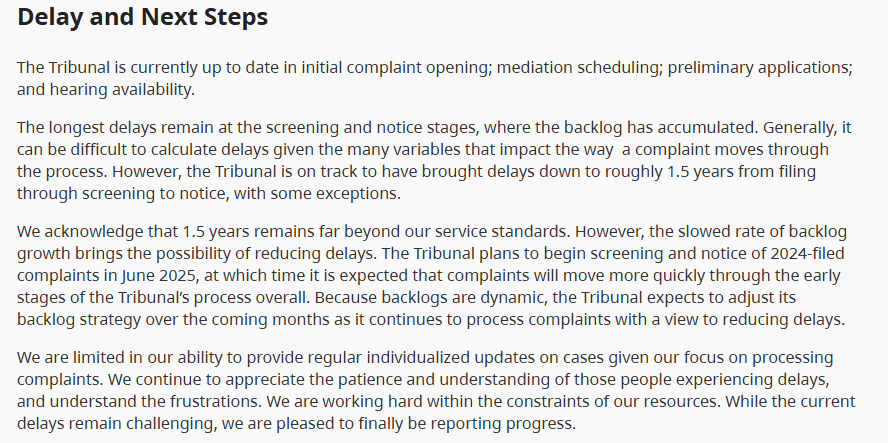
https://www.bchrt.bc.ca/update-from-the-chair-on-backlog-and-delay/
I’m getting off track, which is unsurprising. I’ve come to this blog with a vague desire to write something about the notwithstanding clause, as it’s before the courts, and Charter section 2(d), freedom of association.
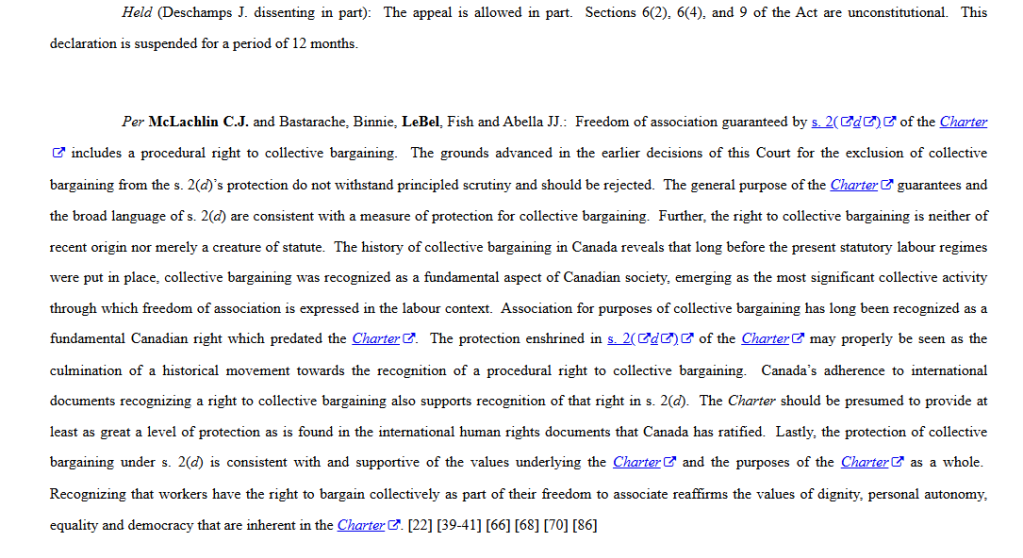
Prior to 2007, when the Supreme Court of Canada (SCC) overruled its previous jurisprudence on 2(d), the section had been stripped of any substantive meaning. That meant governments, like our BC Liberals (read: BC Conservatives, as they eventually rebranded), were free to systematically tear up collective agreements and impose new contracts across sectors—education, post-secondary, health care—on thousands of workers.
It was a challenge to the legislation that tore up the agreements of BC Health Care workers that led to that change to Charter interpretation, at least with respect to 2(d). The court clearly stated that freedom of association includes a right to bargain collectively.
When Health Services came down, I was working in the legal department of a nonprofit, still searching for articles months after my LL.B. graduation. (For the record: I never articled and somehow ended up on a winding life path that leads me almost 20 years later to be submitting BCHRT complaints, unlikely to amount to anything, over demeaning treatment that could be, in my mind, easily solved by simple transparency and formal compensation structures). I had written my major paper in law school on 2(d) as my own memory of having been legislated back to work by that Gordon Campbell BC Liberal (read: BC Conservative) government—as a post-secondary worker—was still relatively fresh in my mind.
I want to express how heavy-handed back to work legislation feels when you have been an active union member, as I was, and captaining a picket line, as I was, months into a bargaining process, as we were, only to hear that my government had passed a law to bring the entire thing to a halt and to impose the deal they wanted. But that was prior to 2007 and 2(d) had been emptied of all legal meaning. So they were free to do it.
What I think about now is how they are still free to do it. Section 33, the notwithstanding clause, lets any goverment pass and enforce a law that violates some of our rights under the Charter as long as they say so explicitly. That includes freedom of association.
The use of the Charter is presently before the SCC because of a Quebec law that prohibits religious attire in workplaces. My cursory understanding is that Quebec wants to renew this law, because the five year limit of its use of the notwithstanding clause is up.
I wasn’t really aware this debate was going on. I didn’t have a sense of the growing use, or ease with provincial governments in proposing the use, of the clause in recent years. I only looked it up after I watched Question Period on September 17 and saw Mark Carney’s exchange with Bloc leader Yves-François Blanchet.
Mark Carney said it’s the job of the government to defend the Charter, by which we have to assume he meant the rights and freedoms in the Charter, not necessarily government’s ability under the Charter to override those rights. It’s the type of comment I like to hear from Mark, good ‘ol Mark, because you feel it’s sincere, you feel everything Mark does is sincere.
(Side note: I dislike many of the policies of this new Liberal government—like massive increases in defence spending that will use up a huge amount of the federal budget and fast tracking mining projects—but much in the way I hate that I should use those vegetables in my fridge to make a beet and orange salad instead of eat half of the discounted birthday cake I brought home from Safeway. The environment will suffer under this government, but it would have suffered worse under the alternative, and Canada right now has limited tools in its economic and strategic toolkit.)
Fundamentally, we don’t think about our rights until they might be taken away (think a government that wants to use section 33) or we discover they are difficult to enforce (think of the 1.5 year long wait for BCHRT complaint processing). As Canadians, we also tend to spend little time thinking about our own politics because of the noise of what happens in the U.S. America can be very, very, very loud, but ultimately we do have to pay attention first to what happens in our own house.
I filed the BCHRT complaint only after a long summer of commiseration with co-workers about various ongoing, serious instances of poor treatment. Myself and another want to organize, or at least start an organizing drive. A union doesn’t solve all problems, but it’s a beginning. And it is in practical terms the only mechanism we have. I have a call with a union organizer in a few hours, and I have hope, that we can move forward, while we still have the right to do so.

 Mark Carney is Awesome
You must be logged in to post a comment.