This post has been rolling around in my brain since last Wednesday, when Mark Carney told the Vancouver Board of Trade his maternal grandfather worked in the copper mine at Britannia Beach.
I’m taking that phrase directly from the video of his speech, because it’s important. Mark Carney, who chooses his words deliberately, and corrects himself immediately when they come out in a way he didn’t intend, says his grandfather worked in the mine at Britannia, not at the mine at Britannia. In the 1930s, 40s, and 50s, as he goes on to say.
The implication is that Carney’s grandfather was a miner, at a mine that once made a lot of money for its owners, until the money was no longer there, life in Howe Sound was eviscerated, and the workers had already given some of the most precious parts of themselves.
Carney makes breezy reference to Britannia as the place where his mother grew up, before the highway that would transport folks from Vancouver through Britannia to Squamish and Whistler and beyond, as it does now, when Britannia was only accessible by boat. I take the quote from Wikipedia here:
“Britannia Beach was a company town with its own company store. Workers lived in town and were unable to leave except by scheduled Union Steamship Company boat. Highway 99 was not completed until 1955. The company was very strict with its workers and difficult to work for. The company was unionized only after the war, in 1946. Men had few safety precautions and used hard rock air drills without ear protection. Britannia Beach miners would often go deaf, receiving no compensation.”
Whether or not you believe Wikipedia, I can assure you the tour at Britannia Mine Museum, which I have taken, tells you pretty much the same thing. The tour guide does a stunning demonstration of what it was like for miners to have to scrape for tiny bits of copper, by candlelight, in physically deplorable conditions.
It’s been a couple of years since I’ve taken the tour. But it had a lasting impact on me, as did that sign marking the remediation project of Howe Sound. The mine, as it was killing its workers, was also killing all life in Howe Sound. The repair work didn’t start right away, but it has, and it’s been largely successful.
But of course, remediation, repair isn’t erasure or removal. The union that came into the mine didn’t fix the hearing of those workers who’d scraped the metal from the rock years before, and the fish that swim in Howe Sound now share no lineage with those who died because of toxic poisoning decades before.
Britannia Beach will never be what it was before the mine, because of the wounds, and scars, that have been left. They’ve tried to make Britannia into more of a destination spot in recent years, a place where people actually stop instead of driving past on the way to Squamish and Whistler. But it’s hard to forget what happened there, with the remediation sign, and the mine museum itself and its old infrastructure which dominates the landscape.
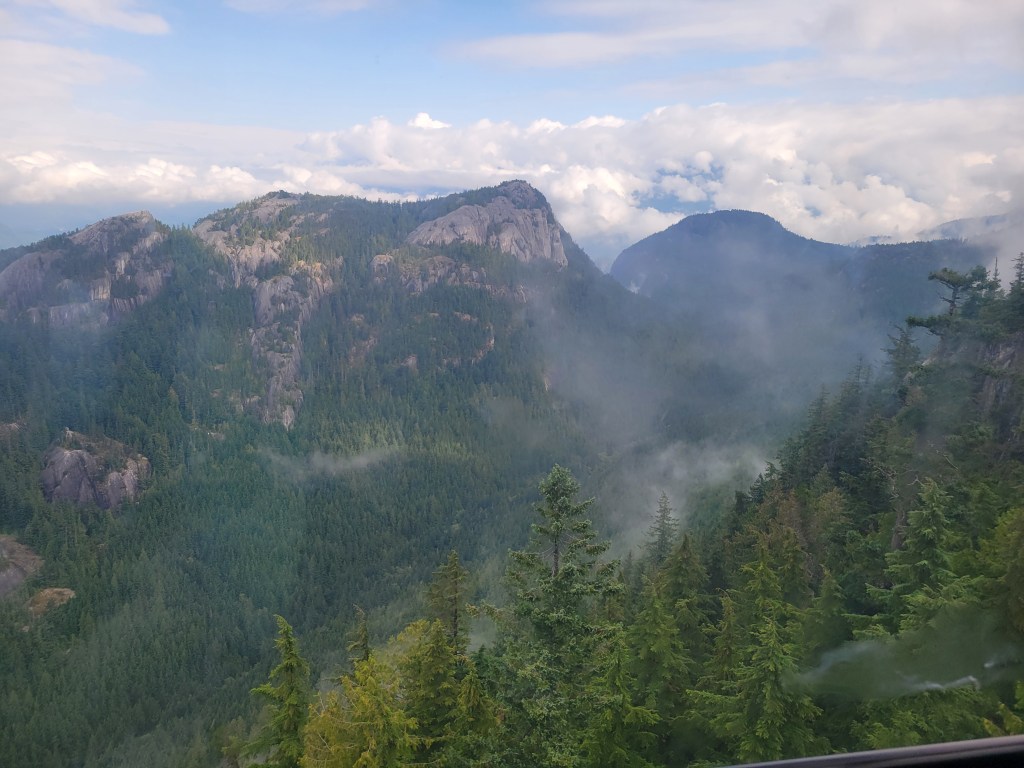
It is, let’s not forget, on one of the most stunning stretches of coastline in the world. At least I think. I recommend to anyone driving up to Whistler to have someone else take the wheel, or better yet, save the environment a little carbon and take a shuttle. Look at the view. It’s extraordinary, and amazing that generations were willing to sacrifice a piece of it for a toxic and dangerous industry that, let’s remember, made a lot of money, until it didn’t.
So here’s Mark Carney, speaking to the Vancouver Board of Trade, telling the crowd about his connection to Britannia Mine. In a speech that everyone expects will involve explaining his recent deals to open the door to a west coast pipeline from Alberta.
Obviously, Britannia Mine holds emotional resonance for me, even if mining stopped there in 1974, the year I was born, and my own parents had only come to British Columbia a few years before that from Montreal. From that perspective, Carney might have more British Columbia cred than I previously gave him credit for, since his roots here seem to run a little deep.
But the real story, politically, or from a communications perspective, is not about cred. It’s about making us believe that he gets it. That when we’re talking about these big natural resource projects, that he understands. He understands what they might mean for workers and for the earth.
Invoking Britannia Mine is a surefire way to tell his audience, his critics and adversaries, that he gets it. When he told that story you got a real sense of how people, let’s say diehard social conservatives, could sit in a room with Mark Carney and come out wanting to join his party. He makes you believe that he understands, that he cares, and that his caring and understanding underpin the choices that he’s made and will make.
But it’s at that last point that the promise isn’t playing out, and is telling us a little something about Mark Carney, the choice-maker. He is someone who feels the weight of his ancestral history, whether it’s his maternal grandfather or his own father, who has a complicated history with residential schools. In his Board of Trade speech, Carney went straight from talking about Britannia to spitting out his talking points about “building the right way,” that protects workers and the environment and is in partnership with First Nations. He at once seems to understand the long game, but is willing to shortchange what is truly priceless. Would the person who truly understood the lessons of Britannia really consider lifting the tanker ban to ship crude oil to new markets?
My guess is no, which leaves me to wonder where his end game actually lies. Mark Carney seems to draw upon the history of his ancestors as a kind of moral compass of his own actions. So going on that basis, why would he sign this MOU with Alberta that deepens the bet on crude, albeit with elements that are climate protective?
I’m not a conspiracy theorist, I won’t say it’s about Carney’s blind trusts or assets he’ll have access to once his Prime Ministership is over. I think it’s more straightforward than that. I think it’s about Alberta. I think it’s about keeping Alberta in the fold. Whether it works or not is an entirely different question, as it seems everything to do with Alberta has backfired, whether it’s for Danielle Smith or Mark Carney. But the ancestors are watching, and their sacrifices we have to remember, so we don’t repeat the same mistakes.